“It’s Leaking Again” — Those Dreaded Words
Whether you’re in the water treatment, chlorine, or bottled gases industry, few words cause the same dismay as those three. The natural inclination is to blame the sealant, but in many cases, the sealant is not to blame.
Fluoramics has done a fishbone analysis on the causes of leaks, and we will break down the elements in this eight-part series.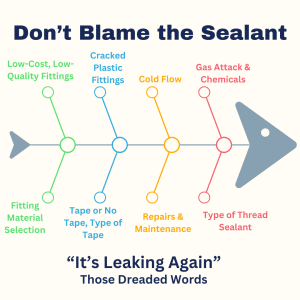
- Low-Cost, Low-Quality Fittings
- Fitting Material Selection
- Cracked Plastic Fittings
- Tape or No Tape, Type of Tape
- Cold Flow
- Repairs & Maintenance
- Gas Attack & Chemicals
- Type of Thread Sealant
Today we will wrap up the series by focusing on the eighth part: Type of Thread Sealant
Not all thread sealants are created equal. Differences in base chemistry, curing behavior, and chemical compatibility mean that a sealant that works perfectly in one environment might fail in another. Here’s what to consider:
Water-Based vs. Non-Water-Based Sealants
- Water-based sealants are convenient for more general applications and have easy cleanup.
- Non-water-based sealants are designed for durability, chemical resistance, and sealing performance under extreme conditions. These are essential for systems carrying aggressive chemicals, high-purity gases, or operating under high pressures.
Hardening vs. Non-Hardening Sealants
- Hardening sealants cure over time to form a rigid, tight seal. While great for some permanent installations, they can crack or fail
 under vibration or stress.
 - Non-hardening sealants stay pliable, allowing them to flex with the pipe movement, temperature fluctuations, and system vibrations without losing their seal.
Chemical Compatibility is Critical
The material flowing through a system — whether it’s chlorine gas, oxygen, sulfuric acid, or caustic soda — attacks and degrades incompatible sealants. Over time, this chemical exposure causes sealants to soften, swell, crack, or completely dissolve, leading to leaks.
Temperature and Pressure Ratings Matter
Sealants must be able to withstand the operating temperatures and pressures of the system.
- Exposing a low-temperature-rated sealant to high heat causes it to liquify or degrade
- High pressures force inadequately rated sealants out of threaded joints
Right Sealant, Right Application
When it comes to leaks, the type of thread sealant matters just as much as the application technique. Using a general-purpose sealant in a high-stress, chemically aggressive, or high-purity system leads to premature leaks — no matter how perfectly it was applied.
- Choose a sealant built for your environment
- Confirm chemical compatibility
- Understand temperature and pressure limits
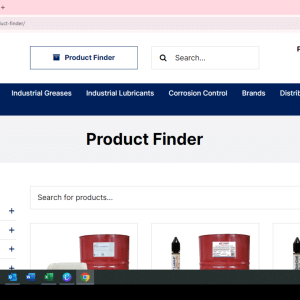
Find Out Which Fluoramics Thread Sealant is Right for You
Thanks for reading our series. Assuming you’ve found the source of your leaks, Fluoramics’ sealants are an excellent option to ensure no further leaking. If you’re not sure which Fluoramics sealant to use, Ask an Engineer, or use the Fluoramics Product Finder to find the right sealant for you.
With the Product Finder, you can search for specific products, or you can use the product filters on the side. You can filter by product line, industry, packaging, brands, attributes, and packaging. These filters are designed to make it easy for you to find the specific qualities you need in a product.
For a step-by-step guide (with visual instructions) on how to use the product finder, read more here.
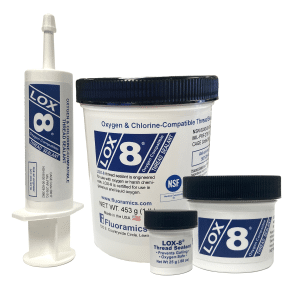
Shop LOX-8 Thread Sealant Now> LOX-8 Thread Sealant
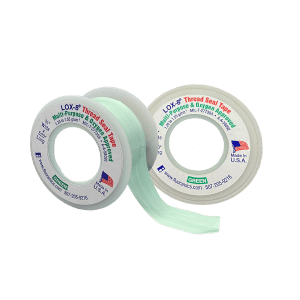
Shop LOX-8 Full Density Green Oxygen Approved Thread Seal Tape Now> LOX-8 Full Density Thread Seal Tape
Shop LOX-8 Full Density FDA Approved White Thread Seal Tape Now> LOX-8 Full Density Thread Seal Tape – FDA Approved
Shop LOX-8 Full Density Yellow Thread Seal Tape for Gas Lines Now> LOX-8 Full Density Thread Seal Tape — Gas
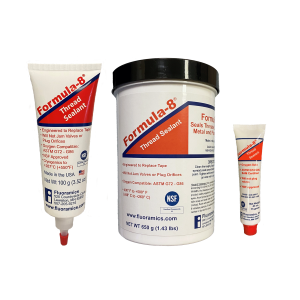
Shop Formula-8 Now> Formula-8